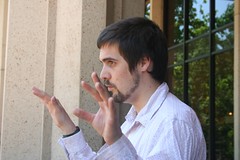
from a recent email to a dear friend
Just got back from a conference in way upstate New York (SUNY Plattsburgh, which is like an hour south of Montreal). Presented some research I'm pulling together around an oral history project I've been involved in. Exciting to frame, package, and present work. In conversations with others at the conference, it seems like I'm not completely off track. Can't wait to press the big pause button this summer and start connecting the dots. And, if nothing else, write.
That being said, it's hard defining one's interests by negation, which is seems like I'm doing a lot of. Walking around with a bundle of ideas A, B, C in my hands, and peering in doors 1, 2, and 3 to see if I want to bring my things inside, and winnowing. Mostly a sense of: no, I don't really walk into the Literature door; no, I don't really want to walk into the Composition door; I'll but a little sticky note by the Rhetoric door but I'll walk around some more; oh, I haven't thought about the MFA door in a while; didn't there used to be a Cultural Theory around here? A Postcolonial door?; hey you, just walking out of the Writing Studies door, what was it like in there? Of course, the fantasy is that the direction would be reversed. That I could stand on a park bench somewhere with a big sign that says: "This guy wants to think about the following things: (a) the rhetoric of community identity and community change (b) social networking, user adaptive databases, and public discourse, (c) Mississippi ethos shifts in the post-segregation moment, (d) public discourse on cultural symbols and the legacy of race, (e) national conversation about governance and social policy and the right wing of American politics, (f) the composition of pedagogical exchange and distribution, (g) et cetera." And then have the occasional person come up and say, "Hey, a bunch of other people and I are thinking about similar stuff. We should hang out. Do you mind teaching undergrads? No? Cool. Sign here."
I'm sure it's somewhere in the middle, as most things. Certainly not a linear hallway with discrete, mutually exclusive doors. Maybe closer to the Library of Babel. Or the Venn Diagram of All Things. And maybe not a park bench, but a school dance. The tying of ties, the two step.


3.04.2010
on admiral ackbar
i was asked to weigh in on the visitsouth.com "points of interest" blog post about the strange and growing campaign to name admiral ackbar the new on-field mascot for the university. thought it was worth re-posting here:
"A sense of humor and a bit of playful irony is pure catharsis for a conversation that usually entails a very complicated negotiation of terms. University symbols (official or not) like Colonel Reb, "From Dixie with Love," the Rebel Flag, etc. are deeply entrenched in both complicated/problematic history and significant tradition. It's very hard, if not impossible, to respect all the interests at hand: tradition-maintainers trend towards suggesting these symbols are so flexible and contextual as to not mean anything other than "tradition" itself in some settings (which at times comes across as a cover for the ability to apply more concrete meanings to these symbols in other settings), and proponents of change trend towards viewing these symbols as being so rigid as to not having any room to grow beyond their more difficult meanings. Ackbar is, in short, a breath of fresh air: a welcome departure from the head-butting of both well-trod "Save Colonel Reb" pleas and of arguments for change that seem to lack the strength of argument about possible destinations that they have for the need for moving forward.
Also, of all the signifiers at play, I personally think that "Rebel" is the most flexible and the most likely to endure. (Even more so than "Ole Miss," to go out on a limb.) And, Ackbar, admiral of the noble underdog Rebel Alliance, is a perfect example of the kind of symbolic rearranging that may help the University turn the corner on the mascot issue (more so than Rowdy Reb, at least). Of course, there's always the possibility of conversations tailspinning into discussion of the politics of the actual rebellion that provided impetus for the school's association with the term "Rebel", but I see more hope for transition on Ackbar-like grounds than I see in things like a Colonel Reb-or-no-mascot-at-all stance. There's something about the spirit of things in the against-all-odds, fighting-the-good-fight, David-and-Goliath realm that has people pointing at Ackbar as a possible avenue for retaining the valuable notions of "being a rebel" in a way that can dislodge the direct ties with the irresolvable local politics of that the Colonel will always be a visual tie to. And, the tongue-in-cheek adoration we see in regards to Ackbar is I think a legitimate commentary on how self-important the Colonel Reb discussion can feel sometimes. It kind of boils down to: weeks of tail-chasing back-and-forth about "Dixie with Love": not-awesome; blowing up the Death Star: awesome. If only it were that simple."
note: i've recently been writing as the oxford insider for visitsouth.com, often finding myself writing (no surprise) about race & history:
"A sense of humor and a bit of playful irony is pure catharsis for a conversation that usually entails a very complicated negotiation of terms. University symbols (official or not) like Colonel Reb, "From Dixie with Love," the Rebel Flag, etc. are deeply entrenched in both complicated/problematic history and significant tradition. It's very hard, if not impossible, to respect all the interests at hand: tradition-maintainers trend towards suggesting these symbols are so flexible and contextual as to not mean anything other than "tradition" itself in some settings (which at times comes across as a cover for the ability to apply more concrete meanings to these symbols in other settings), and proponents of change trend towards viewing these symbols as being so rigid as to not having any room to grow beyond their more difficult meanings. Ackbar is, in short, a breath of fresh air: a welcome departure from the head-butting of both well-trod "Save Colonel Reb" pleas and of arguments for change that seem to lack the strength of argument about possible destinations that they have for the need for moving forward.
Also, of all the signifiers at play, I personally think that "Rebel" is the most flexible and the most likely to endure. (Even more so than "Ole Miss," to go out on a limb.) And, Ackbar, admiral of the noble underdog Rebel Alliance, is a perfect example of the kind of symbolic rearranging that may help the University turn the corner on the mascot issue (more so than Rowdy Reb, at least). Of course, there's always the possibility of conversations tailspinning into discussion of the politics of the actual rebellion that provided impetus for the school's association with the term "Rebel", but I see more hope for transition on Ackbar-like grounds than I see in things like a Colonel Reb-or-no-mascot-at-all stance. There's something about the spirit of things in the against-all-odds, fighting-the-good-fight, David-and-Goliath realm that has people pointing at Ackbar as a possible avenue for retaining the valuable notions of "being a rebel" in a way that can dislodge the direct ties with the irresolvable local politics of that the Colonel will always be a visual tie to. And, the tongue-in-cheek adoration we see in regards to Ackbar is I think a legitimate commentary on how self-important the Colonel Reb discussion can feel sometimes. It kind of boils down to: weeks of tail-chasing back-and-forth about "Dixie with Love": not-awesome; blowing up the Death Star: awesome. If only it were that simple."
note: i've recently been writing as the oxford insider for visitsouth.com, often finding myself writing (no surprise) about race & history:
2.01.2010
prosepost: the house on the empty lot
for lizzie. a half-fiction about trees.
One-Nine-Seven-Six-Oh South Sagamore Fairview Park Ohio Four-Four-One-Two-Six.
Two were in the front. One a scraggly crab apple thing that filled the ground with devilish green marbles for twisted ankles and bruised arms and which rotted faint and sour. And its neighbor, of the suburban pastoral: sturdy hips at the trunk underneath a robust, leafy afro. Lower branches both imminently reachable and lovingly sturdy. Thick, well-spaced diversions with climbable veins up nearly to the height of the house. The only mistaken branch was a perfectly horizontal hangnail, bark bare and peppered with wormy intrusion--it gave way once while I was dangled on it, considering a pull-up.
Then the immense, shady resident of the empty lot between our house, the sturdy house (with the sturdy tree and the crab apple thing), and the blinding-white-with-black-shades house of the neighbors. Googie and Peg, mother and daughter, lived there. Googie had hair like snow or cotton and seemed to subsist on hard candy and daytime television. Peg was (looking back on it) a smoker and a dancer, with hair kept meaningfully short and gray with knowing. She died of breast cancer after moving to Texas. Googie just sort of evaporated, like sunshine. They kept the most vivid garden, with colors clear and bright enough to be painful, so you always kind of looked beyond the petals or at some buzzing speck. I was behind the garden digging when I chanced upon an odd thing--corpse white, with candy red dots for eyes. It was the size of a wine cork, and looked like an albino bee with no wings and mantis claws. I touched it with my finger and it pinched me hard enough to scream, ripping the thing in half as I yanked my finger back. Its insides were an oatmealy pulp, the same color as its skin, and the candy eyes never looked away.
The tree there in the empty lot was like a gigantic god that you didn't have to think about being there or not, and seemed content to be generally ignored as it went about its business of shade and squirrel-bearing. At the back of the lot was Googie's chalk-white bird feeder that seemed as ancient as she was and in which I thought the coldest water sat. I knocked the basin off the bird feeder once and stood there watching the slimy soot at its bottom glisten in the sun, while the gigantic tree looked down on me and smiled in kindness.
Pines lined the side of the house facing the empty lot. I knew they were pines because of the needles, and the sap that stuck on my fingertips even after washing, and the shale-chip bark that would jump off if you ran a stick up and down the trunk.
Two of the pines went down while we lived there--felled by lightning just months apart. Mom said it was because of the young boy who died of cancer and who lived in the house before we did. He didn't want us to move. I wasn't sure about the lightning, but I was sure about these things: (1) that his name was Michael (like my brother's), (2) that he appeared in my dreams once: lying in bed and someone coming up the stairs very bad. run to parents' room and knock frantically. no answer. try the doorknob and it doesn't turn, except it finally does and open the door to see two people sitting straight up in my parent's bed who aren't my parents. someone coming up the stairs very bad about to turn the corner and back in bed pull sheets over. then the shadow bending above and through sheet two eyes glow electric red. (3) that he helped me once. We were moving out of the sturdy house into another one in the same neighborhood. My sister Sarah was a surprise--she was the last and I was the first--and after Mikey had a hard time sleeping in the room with her we switched rooms because I was able to handle the ceaseless whirr and whine of the hamster wheel when we had a hamster and now I would handle the excited squat-thrusts of a diapered baby when we had a baby. Sarah held onto the crib railing and bobbed up and down and talked to the universe. We needed a bigger house so we moved to one, and along the way lightning hit two of the pine trees on the side of the house facing the empty lot. On one of the moving days, Dad was yelling at me and backed me into the open trunk of the station wagon, and instead of being afraid or sad I became angry back, spitting red electric angry, and told him he better not. After which Dad went back in the house, slamming the screen door, and I stayed in the station wagon still aglow. Some minutes later Dad returned impossibly quiet, and with an absence he finished packing the car for a trip to the new house. Later, Mom said that he had gone up to my old room to get some boxes, and saw that the floor was covered in wood splinters. A baseball bat--bisected lengthwise and upon which was attached some wooden knobs, thereafter nailed to our childhood closest wall for the hanging of our childhood jackets--had been torn off the wall and broken in half. No one else had been in the house, except maybe Michael.
There is a house now on top of the empty lot. It sits uncomfortably, faceless and forced like it's filling in for a dead guitarist. The house is right there where the gigantic tree was, and the bird feeder. The sturdy tree and the crab-apple thing are gone, too--replaced by teenage-looking implants, gangly out of proportion and awkwardly not-yet-full. I still drive past sometimes, when I'm in Cleveland, and try my best to remember. But I'm not sure what happened to the rest of the pines.
One-Nine-Seven-Six-Oh South Sagamore Fairview Park Ohio Four-Four-One-Two-Six.
Two were in the front. One a scraggly crab apple thing that filled the ground with devilish green marbles for twisted ankles and bruised arms and which rotted faint and sour. And its neighbor, of the suburban pastoral: sturdy hips at the trunk underneath a robust, leafy afro. Lower branches both imminently reachable and lovingly sturdy. Thick, well-spaced diversions with climbable veins up nearly to the height of the house. The only mistaken branch was a perfectly horizontal hangnail, bark bare and peppered with wormy intrusion--it gave way once while I was dangled on it, considering a pull-up.
Then the immense, shady resident of the empty lot between our house, the sturdy house (with the sturdy tree and the crab apple thing), and the blinding-white-with-black-shades house of the neighbors. Googie and Peg, mother and daughter, lived there. Googie had hair like snow or cotton and seemed to subsist on hard candy and daytime television. Peg was (looking back on it) a smoker and a dancer, with hair kept meaningfully short and gray with knowing. She died of breast cancer after moving to Texas. Googie just sort of evaporated, like sunshine. They kept the most vivid garden, with colors clear and bright enough to be painful, so you always kind of looked beyond the petals or at some buzzing speck. I was behind the garden digging when I chanced upon an odd thing--corpse white, with candy red dots for eyes. It was the size of a wine cork, and looked like an albino bee with no wings and mantis claws. I touched it with my finger and it pinched me hard enough to scream, ripping the thing in half as I yanked my finger back. Its insides were an oatmealy pulp, the same color as its skin, and the candy eyes never looked away.
The tree there in the empty lot was like a gigantic god that you didn't have to think about being there or not, and seemed content to be generally ignored as it went about its business of shade and squirrel-bearing. At the back of the lot was Googie's chalk-white bird feeder that seemed as ancient as she was and in which I thought the coldest water sat. I knocked the basin off the bird feeder once and stood there watching the slimy soot at its bottom glisten in the sun, while the gigantic tree looked down on me and smiled in kindness.
Pines lined the side of the house facing the empty lot. I knew they were pines because of the needles, and the sap that stuck on my fingertips even after washing, and the shale-chip bark that would jump off if you ran a stick up and down the trunk.
Two of the pines went down while we lived there--felled by lightning just months apart. Mom said it was because of the young boy who died of cancer and who lived in the house before we did. He didn't want us to move. I wasn't sure about the lightning, but I was sure about these things: (1) that his name was Michael (like my brother's), (2) that he appeared in my dreams once: lying in bed and someone coming up the stairs very bad. run to parents' room and knock frantically. no answer. try the doorknob and it doesn't turn, except it finally does and open the door to see two people sitting straight up in my parent's bed who aren't my parents. someone coming up the stairs very bad about to turn the corner and back in bed pull sheets over. then the shadow bending above and through sheet two eyes glow electric red. (3) that he helped me once. We were moving out of the sturdy house into another one in the same neighborhood. My sister Sarah was a surprise--she was the last and I was the first--and after Mikey had a hard time sleeping in the room with her we switched rooms because I was able to handle the ceaseless whirr and whine of the hamster wheel when we had a hamster and now I would handle the excited squat-thrusts of a diapered baby when we had a baby. Sarah held onto the crib railing and bobbed up and down and talked to the universe. We needed a bigger house so we moved to one, and along the way lightning hit two of the pine trees on the side of the house facing the empty lot. On one of the moving days, Dad was yelling at me and backed me into the open trunk of the station wagon, and instead of being afraid or sad I became angry back, spitting red electric angry, and told him he better not. After which Dad went back in the house, slamming the screen door, and I stayed in the station wagon still aglow. Some minutes later Dad returned impossibly quiet, and with an absence he finished packing the car for a trip to the new house. Later, Mom said that he had gone up to my old room to get some boxes, and saw that the floor was covered in wood splinters. A baseball bat--bisected lengthwise and upon which was attached some wooden knobs, thereafter nailed to our childhood closest wall for the hanging of our childhood jackets--had been torn off the wall and broken in half. No one else had been in the house, except maybe Michael.
There is a house now on top of the empty lot. It sits uncomfortably, faceless and forced like it's filling in for a dead guitarist. The house is right there where the gigantic tree was, and the bird feeder. The sturdy tree and the crab-apple thing are gone, too--replaced by teenage-looking implants, gangly out of proportion and awkwardly not-yet-full. I still drive past sometimes, when I'm in Cleveland, and try my best to remember. But I'm not sure what happened to the rest of the pines.
Subscribe to:
Posts (Atom)